




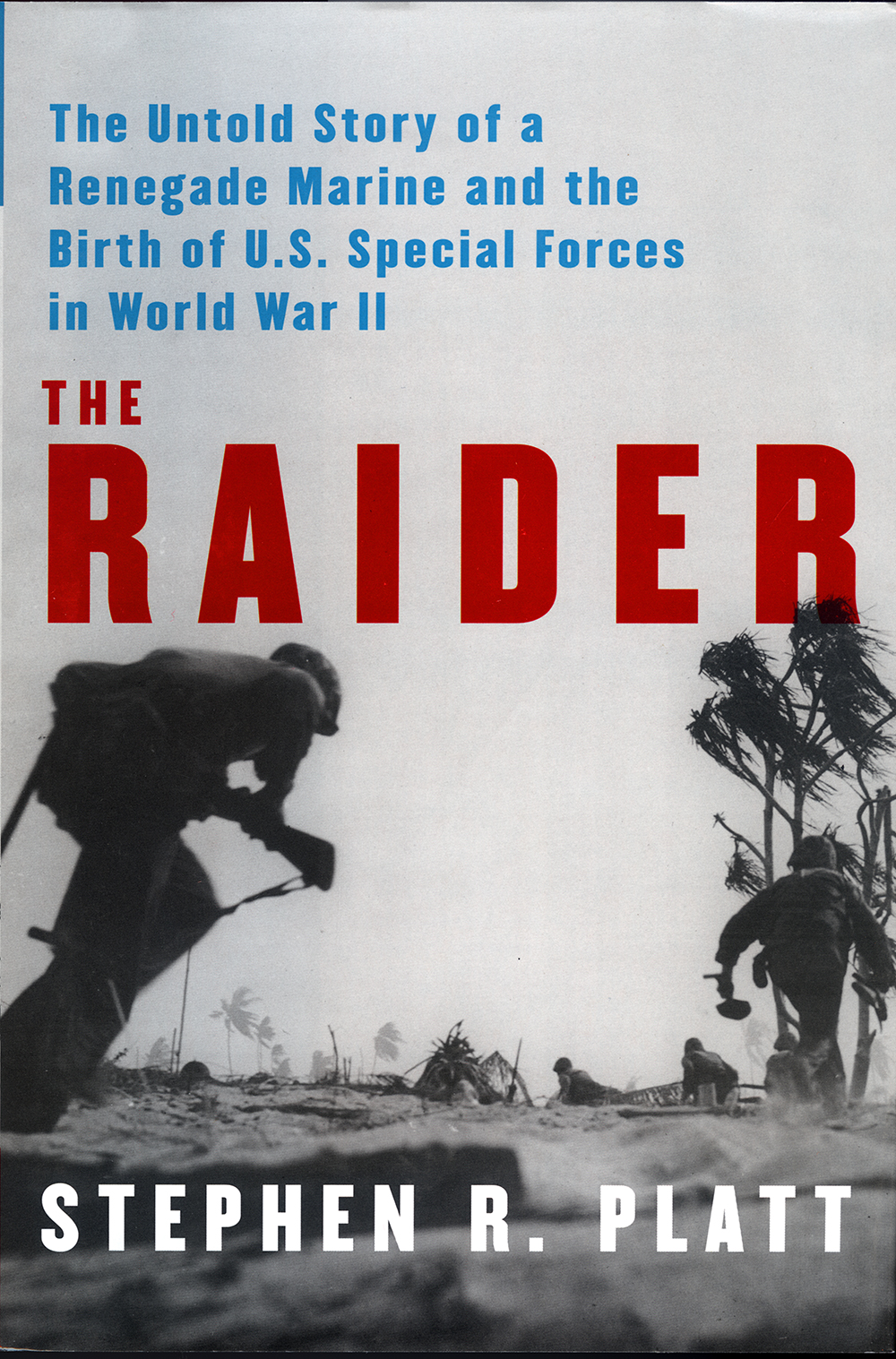
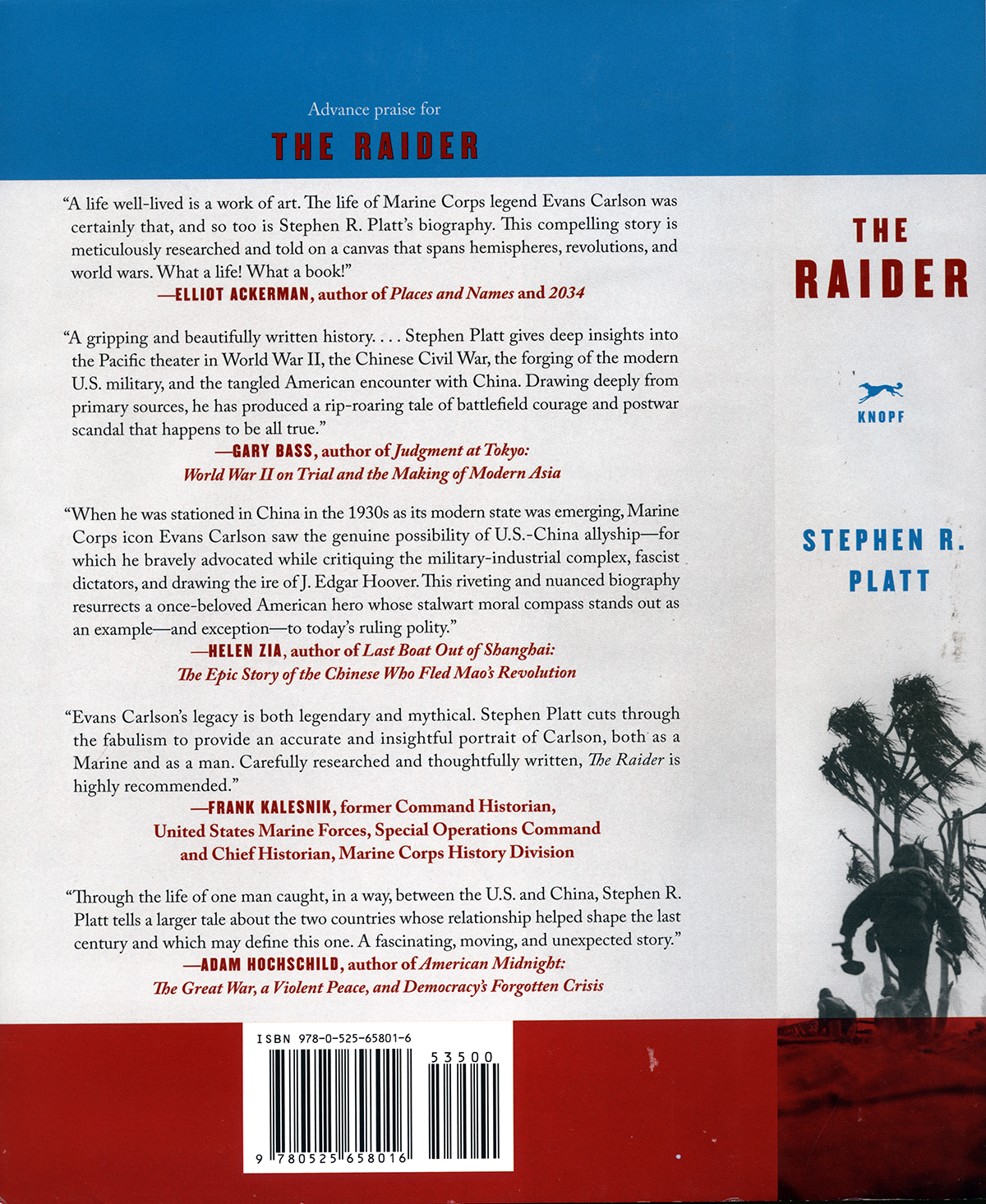
The Raider
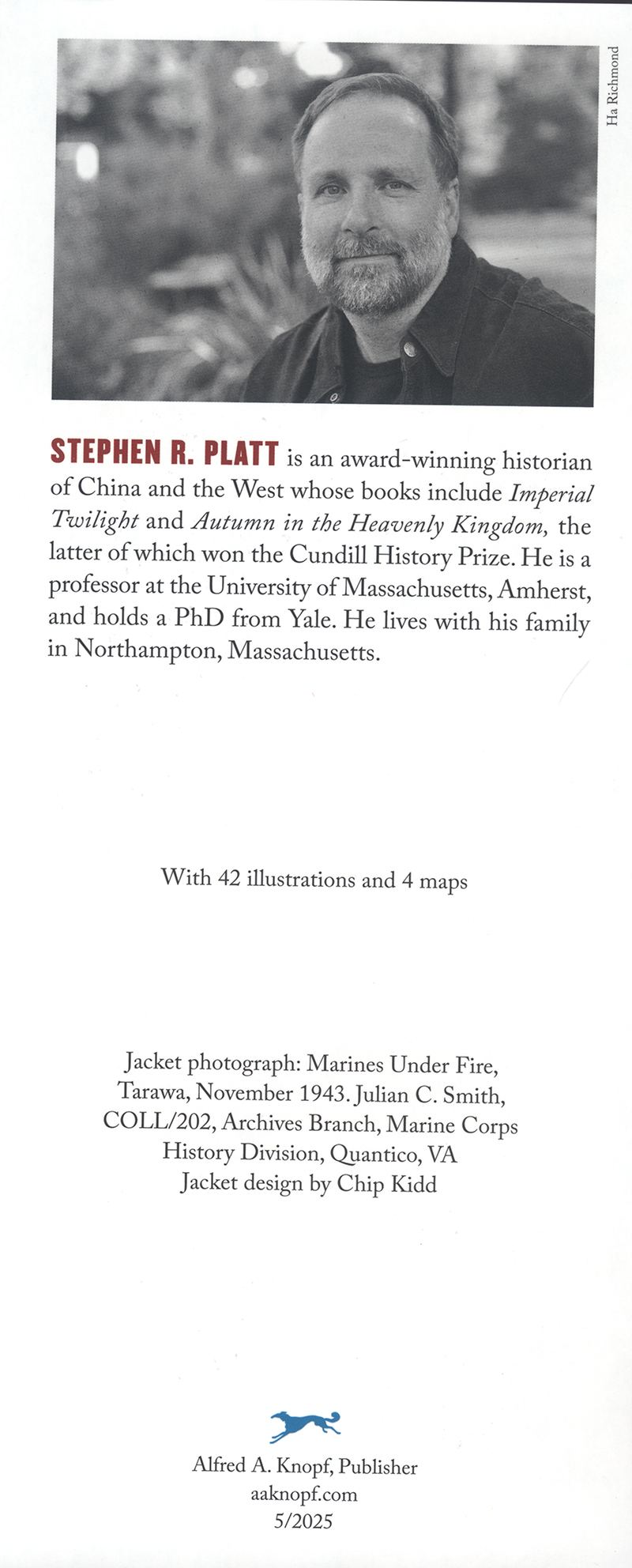
by Stephen R. Platt
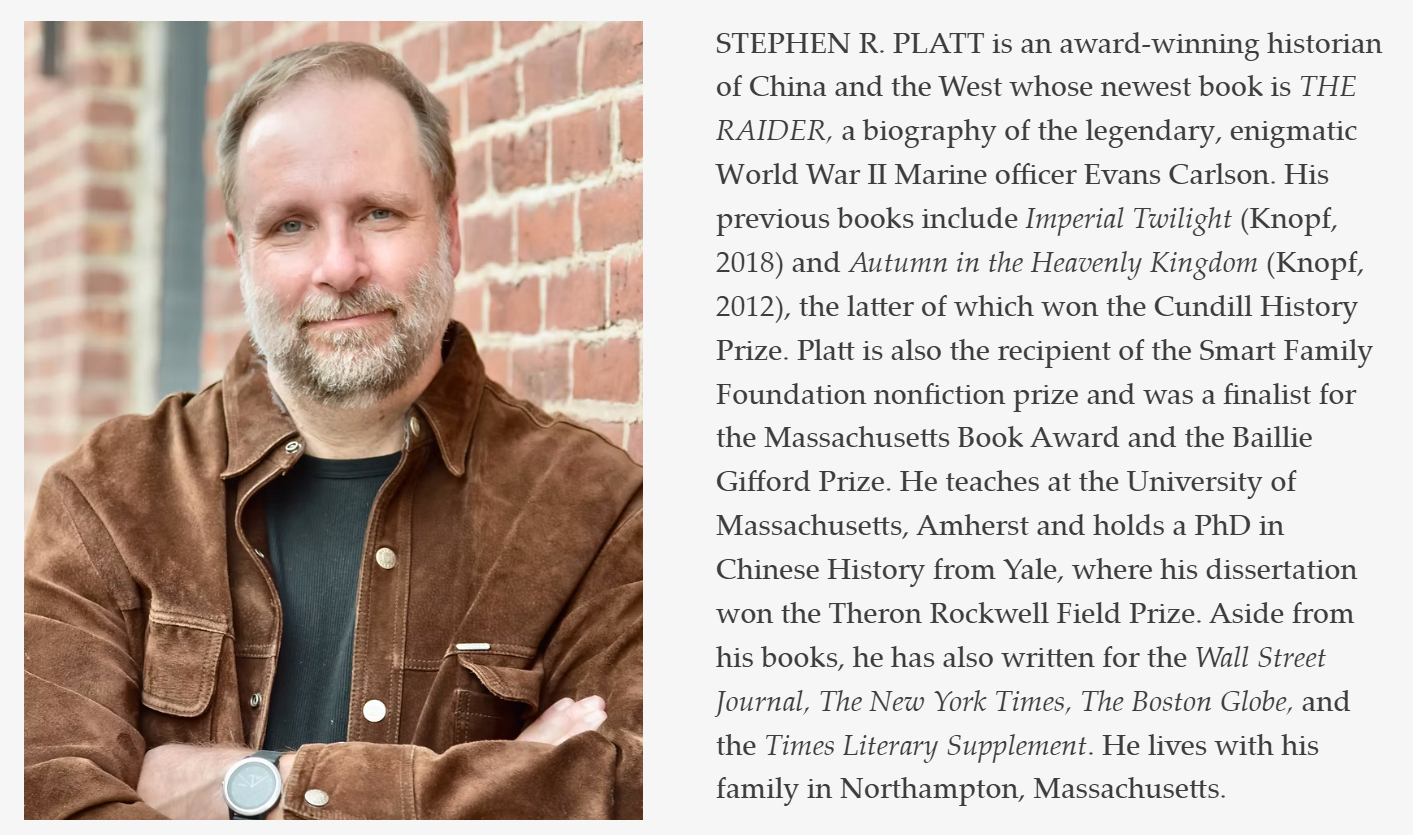
The Author :
Introduction :
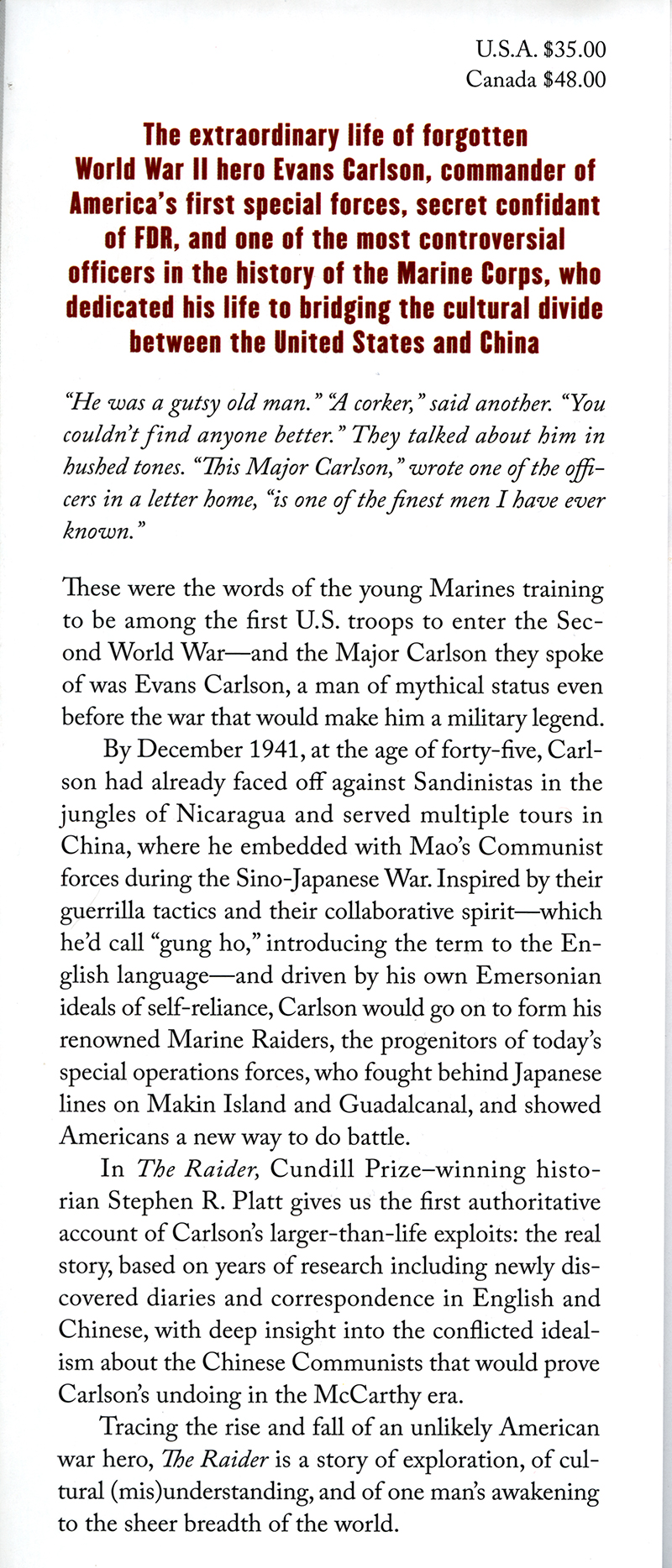
MEET EVANS CARLSON — a tall, lanky, weatherbeaten New Englander with blue eyes and an aw-shucks grin who might be the most famous figure from World War II that you've never
heard of. General Carlson (to use the rank they retired him with) was a legendary figure in the Marine Corps-when they still allowed him to command. He created one of America's first special operations forces, a battalion of Marine Raiders he trained to fight like Chinese guerrillas, and he led them to national fame during the early fighting in the Pacific. He was one of the most decorated Marines of his time, a war hero, a household name. They made a Hollywood movie about him in 1943. He introduced "gung ho" to the English language. According to a war correspondent in 1944, he was the most beloved officer in the Marine Corps to the enlisted men. But there are reasons you may not have heard of him.
When he died in 1947, the Baltimore Sun described Carlson as "the black sheep of the United States Marine Corps." His entire career was hounded with controversy, starting in the 193os when, on a personal mission for President Roosevelt, he embedded as an observer with China's Communist army, traveled with them for months behind Japanese lines, and came out of the experience as an apostle of guerrilla warfare, convinced that the United States must work directly with-and learn from-the Chinese if it was to have any hope of stopping Japan. He was a maverick in the truest sense of the word, whose unorthodox ideas on leadership and military command alienated him from most of his fellow Marine officers, though none of them ever disputed his remarkable courage under fire. He
may have been the black sheep, but his Raider battalion would write legends in the Pacific and some of the tactical features he pioneered would eventually become Marine Corps doctrine. In the small corner of the National Museum of the Marine Corps in Triangle, Virginia, that is devoted to Carlson and his Raiders, the sign under his portrait reads: "Colorful, visionary Evans Carlson emerged from the turbulent 193os as one of the era's most controversial Marines." They could just as easily have left out the words "one of."
Carlson's life was riven by contradictions. He was a dyed-in-the-wool New Englander who found the key to his life's purpose in a foreign land. He was a ruthless battlefield commander who led his men in discussions of social progress and racial equality. He developed a profound sympathy for the people of China but could be a cold, even cruel husband and a distant father. He had lofty literary ambitions but never finished high school. He was deeply religious, the son of a Congregationalist minister, and also a devout admirer of the atheistic Chinese Communists. He was a man who took Emerson's writings on nonconformity to heart as a youth and lived his life by his own conscience, defiant of norms and the expectations of others, yet he found his lasting home in a military career that demanded conformity and obedience as its very lifeblood. He was a World War II hero who would be all but disowned by his service, pilloried as a suspected radical, and forgotten in the postwar era.
This is his story.
When we lift someone out from the fabric of their time to put them at the center of events, part of the background pulls away along with them. In Carlson's case, his life was woven into the grand drama of a world sliding inexorably into war-beginning in China, where his three tours as a Marine intelligence officer largely paralleled the long civil war between the Communists and the Nationalists that would end, two years after his death, with the Communist victory and the founding of the People's Republic of China. That civil war, which shaped China's twentieth-century destiny to an even greater extent than the war with Japan, began as Carlson first arrived in the country in 1927, rolled in waves through his returning tours, and reached its climax as he died in 1947. It was the central conflict of China's
twentieth century, and it would shape the course of Carlson's own life as well.
And then, of course, there is World War II, which-as Carlson experienced it-began not with Hitler's invasion of Poland, or with Pearl Harbor, but with the Japanese invasion of China in 1937. For Western readers, China has long been, to use historian Rana Mitter's term, the "forgotten" theater of World War II, shadowed almost to the point of invisibility by the island-hopping campaigns of the United States in the Pacific. But Carlson's experience gives us a different perspective on these events because for him, the struggles in China and the Pacific were always two halves of a whole. His life formed a bridge between the United States and China in World War II, first as an observer in China, then as a combatant in the Pacific. By the end, he would be a voice in the wind: warning without being heard as the two countries' hopeful wartime alliance spiraled into disaster, giving way just a few years after the defeat of Japan to the slaughter of each other's soldiers on the battlefields of Korea. In the transpacific world we inhabit today-where the U.S. — China relationship is arguably the most important bilateral relationship on earth — we are still paying the price for what happened at the end of World War II. And Evans Carlson saw it coming.
Prologue :
THE GREAT ADVENTURE
Southern California, February 1942
ONE OF THE MEN in line was a dairy farmer from Minnesota who had signed up on December 12, five days after the attack. His brother was a Navy gunner at Pearl Harbor, and when he first
went down to the recruitment office he still didn't know whether his brother was alive or dead. One was a high school student from Arizona who had dropped out in order to enlist. Others had been auto mechanics, policemen, and forest rangers. There was an insurance broker from Connecticut, a football star from Arkansas. There were railroad workers, bartenders, a mining prospector, and at least one labor activist. A few of them had previous experience as Marines, but most had just finished basic training when they heard about the new battalion putting out an outlandish call for volunteers. ("I want men who can walk fifty miles!" the recruiter shouted. "I want men who ain't afraid to die!") They all came together in this long, winding line outside a dusty administrative building by the parade ground at Camp Elliott, the Marine Corps base northeast of San Diego. One of them said it felt like they were cattle at a rodeo: the door to the building would open, one man would go through. The door would close. The line would advance a step. The other side of the door was a mystery.
They had all heard stories about the commanders. One was a name everyone knew: James Roosevelt, the president's son. He was executive officer, second in command. But it was unclear what he was doing here, in this particular unit. The one above him, the commanding officer, they didn't know much about, but the stories were wild. Most had only seen him from a distance. He was a tall, thin, gritty
0
man with big ears and a shock of bristly gray hair. He was a major and his name was Evans Carlson, but among themselves they just called him the Old Man. Some said that he'd gone a thousand miles behind Japanese lines with the Communist army in China. Others said he'd fought the guerrillas in Nicaragua and learned their tactics. Word in the ranks was that he knew how to beat the Japanese. If you wanted to be one of the first ones into the war, they said, you had to get into this battalion. And so you came here and got in line with the others.
On the other side of the door was a spare room with two card tables where Carlson and Roosevelt were conducting interviews. The ones who got Carlson found a wiry-looking man on the other side of the table, his face leathery from exposure. He had sharp blue eyes that watched their reactions intently as he went through his list of questions. One of the men said it felt like having a preacher size you up. The questions were normal enough at the start. What do you do for a living? he asked in a slow, thoughtful voice. Can you swim? He wanted to know where they came from. Did you grow up on a farm? It was conversational. Some of the men lied, telling him what they thought he wanted to hear. The high school dropout pretended to be a ranch hand. The questions kept coming. Are you willing to suffer and go without food or sleep? Why are you volunteering for a service that might cost you your life?
As he went down the list, the questions got progressively stranger.
Can you march thirty miles on a cupful of rice? What would you do if your buddy started panicking behind enemy lines? It wasn't at all clear what the answers to those should be. Do you think you could choke a man to death without puking? How often do you go to Sunday School? Those who passed the interview got his speech. He said the only things he could promise them were hardship and danger. When we go in, he told them, we won't be asking for mercy. And we won't be giving any in return, either.
Six hundred recruits made the initial cut from about six thousand candidates. They were loaded into jeeps and trucks and driven out through the scrub-covered hills to a remote valley studded with live oaks and date palms, the site of an abandoned chicken ranch called Jacques Farm that would be their base for training. There was only one farmhouse at the site and no barracks, so they pitched tents outside in a grassy field. The old farmhouse was the obvious place for
the officers' residence, but when Carlson and Roosevelt arrived at the farm that night, they pitched tents outside just like the recruits. There was no officers' mess either; the next morning, one of the enlisted men found the president's son, Captain Roosevelt, standing next to him in the chow line. It was a bit strange, but it gave the young Marine a good feeling. "The morale of that outfit was something you wouldn't believe," he recalled later.
The men shared an enormous pride in being part of the select group training at Jacques Farm. "It is a crack outfit," one wrote home to his mother, "each man is hand picked. They have the most marvelous spirit I have ever seen." They were living in tents, sleeping on the ground, eating from mess kits, showering and shaving with cold water, washing their clothes in buckets. They trained seven days a week with no leave and they were climbing mountains in a foot deep of mud.
"It's a rugged life," he said, "but we all love it."
A host of instructors came through Jacques Farm to work with them. Some taught them field tactics and riflery. Others were spe-cialists in hand-to-hand fighting with knives and bayonets. One of them had just come back from training with the storied British Commandos, Winston Churchill's elite strike force in Europe. The higher-ups who knew about Carlson's experimental battalion liked to think of it as an American counterpart to the Commandos, but Carlson made it clear to his men that the fighters he was modeling them after weren't British. They were Chinese.
Given the urgency of the war, they condensed months of training into weeks. They scrambled through a bayonet course and learned how to scale cliffs. They learned the art of demolition, and how to land quietly on a beach at night in rubber rafts-the latter skill practiced away from camp, on the California coast. They got basic training in judo and other martial arts. They learned to fire Japanese rifles, in case those were the only weapons at hand. They practiced field stripping them and putting them back together blindfolded. In the field they wouldn't have the luxury of specific, narrow roles, so every man learned how to be a scout. Every man learned the basics of jungle hygiene and how to be a medic.
The standard firearms Carlson issued them were almost absurdly powerful. At the time, a regular eight-man infantry squad in the Marines carried six bolt-action Springfield rifles of World War I vintage and one Browning Automatic Rifle, a light, portable machine gun often referred to by its initials: BAR. By contrast, Carlson organized his Marines into ten-man squads, each broken down into a trio of three-man "fire teams" and a squad leader. Within each fire team, one man carried a BAR, the second a Thompson submachine gun, and the third carried the Army's new Mr Garand semiautomatic rifle-which would later be standard issue in the Marines, but they were the first to use it. The upshot of this density of firepower was that a single three-man fire team in Carlson's battalion effectively outgunned an entire squad of regular Marines.
At forty-six years old, Carlson was more than twice the age of the enlisted men, but he set the pace in their training. They would run a mile before breakfast and then hike up and down the surrounding hills all afternoon and into the night, stopping to cook their own meals of rice in their helmets on the way. The hikes got longer until they hit the promised fifty miles, returning to camp sometimes at three o'clock in the morning.
Carlson said he was going to teach them to march until blood came out of their shoes. "And at the end," he said, "I'm going to be there." To bring the point home, he stayed right by their side in their training-hiking with them, walking with them, running, eating, and talking with them. "You kind of felt good there, you know," recalled one of the Marines. "That man was wonderful." They grew to love him. "He would do anything we could do, plus some," said one. "He was a gutsy old man." "A corker," said another. "You couldn't find anyone better." They talked about him in hushed tones. "This Major Carlson," wrote one of the officers in a letter home, "is one of the finest men I have ever known."
Their physical training was unconventional enough, but it was in the group assemblies that Carlson revealed just how far he intended to depart from the familiar Marine Corps script. He called them "gung ho meetings," and since nobody had ever heard the phrase "gung ho" before, he explained it. He said it was a concept he had picked up in China. It meant working together. It was the secret to making them the most cohesive and effective fighting unit they could possibly be. They needed harmony in their ranks, he told them-full and complete trust in one another. The gung ho meetings would help build
that trust. There would be no insignia on their uniforms in the field and no saluting. They were going to be equals, regardless of status. They were all in it together and the officers would lead by example, not by pulling rank. That was gung ho.
Carlson drilled it into his men that they had to understand why they were fighting. They had to believe in the righteousness of their cause at a deep, moral level. This wasn't just about Pearl Harbor,
he told them. And it wasn't some revenge mission to "kill Japs." It
was bigger than that. They were fighting on the side of democracy
in a global war against fascism. He spoke at the meetings about the reasons why the United States was going into the Pacific. He talked about the ongoing war in China and everything he had seen and learned there. James Roosevelt chipped in as well, talking to the men about world politics, how the United States had gotten into
the situation it was in. How the war against Japan related to the war
in Europe. At one of the meetings, his mother, Eleanor Roosevelt, made a surprise appearance along with the secretary of the navy to , congratulate and encourage the men-as if they needed another boost to their morale.
They spent a lot of time singing together at these meetings. They usually opened with the Marines' Hymn ("From the Halls of Monte-zuma") and finished with "The Star-Spangled Banner." They sang other songs Carlson taught them, and he encouraged them to start writing their own. "Singing helps a man to think," he explained. Sometimes he played a harmonica. He encouraged the enlisted men to speak up, setting aside time for them to ask questions about their training and talk about their lives back home. He pushed them to open up about the things they believed in, but he also tried to get them to talk about America's shortcomings and how it could be made a better society after the war, for all of its members. Because that, ultimately, was their stake, he told them. They weren't just fighting to win the war. They were fighting for a future that would be better than the past.
At the end of April, orders came from above that it was time for them to go. In a few days' time they were slated to depart in a transport for Pearl Harbor-to what remained of it, at least. From there, it would be onward into the vast, murderous Pacific that lay beyond. Admiral Chester Nimitz, the commander-in-chief of the United
States Pacific Fleet, described their battalion as "a striking force with strength out of proportion to its numbers." Later generations would call them special operations forces, though the term didn't exist yet. Their official designation was the 2nd Marine Raider Battalion, but they just called themselves the Raiders-Carlson's Raiders-and to a man, they were ready to follow him to the ends of the earth.
Carlson was pleased with the progress his men had made at Jacques Farm. To his mind, the young Marines of this battalion represented pretty much the best America had to offer. Given the chance, he thought they could utterly cut to pieces a Japanese force five times their size. They were as well prepared, in both body and spirit, as he could make them. The rest was in the hands of God. In his tent on April 29, 1942, he cranked a sheet of paper into his old Olivetti type writer and began tapping out a letter to the president. He addressed it to Franklin Roosevelt directly, at the White House, which was a departure for him. For years, Carlson had been writing his letters to FDR in secret, addressed to the president's personal secretary instead of the man himself. That was the convention he and Roosevelt had agreed on back in the summer of 1937-back when Carlson was just a mid-career intelligence officer preparing for his third tour in China, before the events that had so completely upended the course of his life and now brought him to this place. The letters had been their private subterfuge for all that time-a secret line of communication from one Marine officer directly to the commander-in-chief, an end run around the entire military chain of command. But now circumstances had changed, and his letters didn't have to be secret anymore.
"Dear Mr. President," he began. "We are on the eve of the Great Adventure ... "
Contents :
Introduction xi
Maps xiv
Prologue: The Great Adventure 3
PART I LEAVING HOME
1. The Telegram 11
2. Shanghai 28
3. Bandits 49
4. The Old Capital 64
5. Warm Springs 82
PART II CHINA WAR
6. Into the Cataclysm 93
7. The Reds 113
8. Agnes 131
9. Into the North 149
IO. The Other Side 165
11. Crossroads 181
PART III AMERICAN INTERLUDE
12. Sympathy 205
13. Unheard Warnings 223
PART IV PACIFIC WAR
14. New Beginnings 241
15. Makin Island 257
16. Survival 271
17. Fame and Glory 286
18. Into the Jungle 297
19. Home Fronts 314
20. Backlash 328
21. The Maw 343
PART V HOMECOMING
22. Into the Postwar 365
23. Shifting Grounds 384
24. Forgetting 400
Acknowledgments 419
Note on Romanization 425
Source Notes 427
Bibliog;raphy 481
Index 499